Advantages of Multi-Master Replication in Active Directory
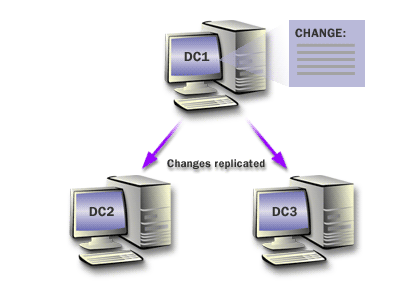
Active Directory Domain Services (AD DS) uses multi-master replication. That means most directory changes can be performed on any writable domain controller (DC), and those changes are replicated to other DCs using a topology that is optimized for your network.
This is a major operational advantage over older single-master approaches, where all updates must be routed through one “primary” server. In AD DS, the directory remains writable even if a specific DC is offline, and administration can be distributed across locations without forcing every change to originate from one site.
Primary advantages of multi-master replication
- No single update bottleneck: administrators (and automated systems) can create users, reset passwords, and update attributes on any available DC.
- Higher availability for changes: updates can continue even if a preferred DC is down (assuming another writable DC is reachable).
- Better performance in distributed environments: changes can be made close to where they occur (for example, in a branch office), then replicated according to site topology instead of forcing every update across the WAN first.
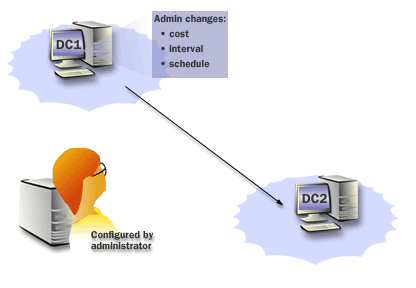
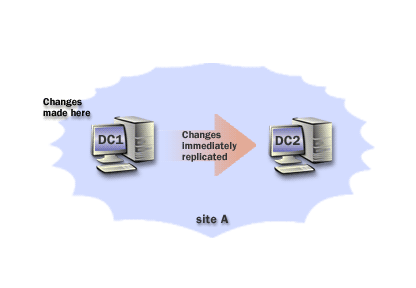
- Replication topology tuned to the network: within a site, replication is designed for fast convergence; across sites, replication can be scheduled and costed to control WAN bandwidth usage.
To get these benefits, you must define a site topology that matches your real network: sites, subnets, and site links. AD DS uses this information to build replication connections and to help clients locate appropriate DCs and services.
The Knowledge Consistency Checker (KCC) automatically generates and maintains replication connection objects based on your site and site link configuration. In other words, you don’t manually wire every replication path—your job is to model the network correctly so AD can optimize the topology.
Why single-master still exists in a multi-master directory
While most directory data is multi-master, some operations must be performed by exactly one DC at a time to avoid conflicts or to maintain consistency. AD DS handles this using FSMO roles (Flexible Single Master Operations).
A role is “single master” because only one DC holds it at a time. It is “flexible” because you can move the role as your environment changes (planned transfer) or recover it when a DC is permanently lost (seizure).
Two FSMO roles are forest-wide:
- Schema Master: controls updates to the Active Directory schema.
- Domain Naming Master: controls adding/removing domains in the forest and certain namespace changes.
Three FSMO roles are domain-wide (one set per domain):
- PDC Emulator: provides time authority (Windows Time hierarchy), handles certain password-change and authentication “fast path” behaviors, and remains the primary compatibility focal point for some legacy operations.
- RID Master: allocates RID pools to DCs so they can create new security principals with unique SIDs (Security Identifiers). (RIDs are part of SIDs; they are not GUIDs.)
- Infrastructure Master: helps maintain cross-domain object reference consistency (primarily relevant when you have multiple domains).
FSMO placement guidance
FSMO role placement is about reliability, performance, and operational clarity. Common, broadly safe guidance includes:
- Place the RID Master and PDC Emulator on the same reliable DC (often co-located for operational simplicity).
- Protect Schema Master and Domain Naming Master with tight administrative controls. These roles are used less often, so security and change control usually matter more than raw performance.
- Domain Naming Master is commonly placed on a Global Catalog (GC) server.
- Infrastructure Master guidance depends on your topology: in a multi-domain forest, avoid placing it on a GC unless all DCs are GCs. In a single-domain forest, it is typically not a high-risk placement concern.
In all cases, document FSMO holders, ensure backups and recovery procedures exist, and treat role transfer/seizure as a controlled administrative operation.