| Lesson 4 | Linux Admin Key Course Features |
| Objective | Explore key course features for Linux Admin |
Linux Network Administration Key Course Features
This course is designed to train you to think and operate like a Linux network administrator. Rather than presenting isolated commands or definitions, the course uses a structured learning approach that combines simulations, exercises, command-line interaction, and reference tools. The goal is to move beyond passive reading and into active system interaction.
Linux network administration is learned through practice. You will not only read about commands—you will execute them, observe their output, and understand how they behave in real-world scenarios. This lesson explains how the course is structured and how each feature supports that learning process.
How This Course Teaches Linux
The course is built around an interactive model that reinforces learning through repetition and application. Each lesson combines:
- Concept explanations
- Command-line simulations
- Guided exercises
- Reinforcement quizzes
These components work together to help you move from recognition to understanding, and finally to independent execution. Instead of memorizing commands, you will learn how to use them in context.
Simulation-Based Learning
Simulations are one of the most important features of this course. They provide a controlled environment that behaves like a Linux terminal, allowing you to type commands and immediately see the results. This removes the risk of damaging a real system while still providing meaningful interaction.
Each simulation is structured to guide your learning. In some cases, you will be told exactly what command to enter. In other cases, you will be given a task and expected to determine the correct command yourself. If your input is incorrect, the system provides hints to help you arrive at the correct solution.
This approach is intentional. It encourages problem-solving and reinforces your understanding of how commands work. Simulations act as a bridge between theory and real-world system behavior.
Practicing Commands in Context
The course introduces commands within realistic scenarios. For example, you may begin by listing files in a directory, then create a file, delete it, and confirm the result. These actions mirror the types of tasks a Linux administrator performs daily.
ls -l
touch newfile
rm newfile
Although these examples are simple, they establish a pattern: observe, act, verify. This pattern is fundamental to Linux administration. Every command you run produces output that must be interpreted correctly.
By practicing commands in sequence, you begin to understand not only what each command does, but how commands relate to one another in a workflow.
Understanding Command-Line Behavior
The command-line interface (CLI) is the primary working environment for Linux administrators. While graphical interfaces exist, servers and remote systems are typically managed through a terminal. The CLI provides precision, speed, and the ability to automate tasks.
Modern Linux systems commonly use shells such as Bash or Zsh. These shells provide powerful features that improve efficiency, including command history, tab completion, and command chaining.
|, &, ;, ||, and &&
These operators allow you to control how commands are executed and combined. For example, you can run commands sequentially, conditionally, or in parallel. Tab completion reduces typing and helps prevent errors by automatically completing filenames and commands.
The command line is not simply a legacy interface. It remains the most effective way to manage Linux systems because it exposes system behavior directly and supports automation through scripting.
Using Help Systems Effectively
Linux administrators do not memorize every command and option. Instead, they rely on built-in help systems to find the information they need. This course encourages you to develop that habit early.
Several tools are available for command documentation:
- echo $PATH: Displays directories containing executable commands.
- help: Lists built-in shell commands and their options (Bash only).
- --help: Provides a quick overview of command usage.
- man: Displays detailed manual pages for commands.
echo $PATH
date --help | less
man ls
These tools allow you to explore commands independently. Learning how to use them effectively is one of the most valuable skills you can develop as a Linux administrator.
File Permissions and Visual Learning
Understanding file permissions is a core part of Linux administration. The course uses diagrams and command output to help you visualize how permissions are applied.
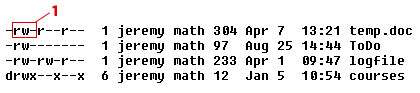
When you run the ls -l command, you see a permission string that describes access levels for the owner, group, and others. For example:
-rw-r--r--
This representation shows which users can read, write, or execute a file. Understanding this format is essential for managing access control, securing systems, and troubleshooting permission-related issues.
Visual examples like this reinforce how command output maps to system behavior. Instead of memorizing symbols, you learn how to interpret them in context.
Multi-Modal Learning Approach
This course uses multiple learning methods to reinforce understanding:
- Text explanations for conceptual clarity
- Simulations for hands-on practice
- Diagrams for visual understanding
- Exercises for problem-solving
- Quizzes for reinforcement
Each method targets a different aspect of learning. Together, they create a comprehensive experience that supports both beginners and more advanced learners.
Navigating Course Content
Some lessons include diagrams, image galleries, or simulation windows. These elements may open in separate windows or overlays. To avoid confusion, you can close these windows after viewing them or position them alongside the main content for reference.
Navigation controls such as Previous and Next buttons allow you to review steps in simulations. This makes it easier to revisit concepts and reinforce your understanding.
Glossary and Reinforcement
Throughout the course, key terms are introduced and reinforced using a glossary. Terms are often highlighted within the text and accompanied by definitions. The glossary provides a centralized reference for terminology used in Linux network administration.
At the end of each module, key terms are reviewed to reinforce retention. This structured repetition helps ensure that important concepts become familiar over time.
You can access the glossary at:
Linux Network Admin - Glossary
Conclusion
The key features of this course are designed to help you learn Linux network administration through active engagement. Simulations allow you to practice safely, command-line interaction builds practical skill, and reference tools help you explore commands independently.
By combining structured instruction with hands-on experience, the course prepares you to work with real Linux systems. You will learn not only how to run commands, but how to interpret results, solve problems, and apply your knowledge in realistic scenarios.
This approach reflects how Linux administrators actually work: observing system behavior, testing commands, and refining their understanding through practice.